
The forgetting curve
Why you forget most of what you read, and why a 140 year old experiment still defines how we learn.
You read something good this morning. By tomorrow, you'll remember maybe half of it. By next week, you'll be lucky to keep a third.
Hermann Ebbinghaus proved this in 1885. He sat alone in a room, memorized lists of nonsense syllables, and measured how many he could still recall an hour later, a day later, a month later. The numbers weren't flattering.
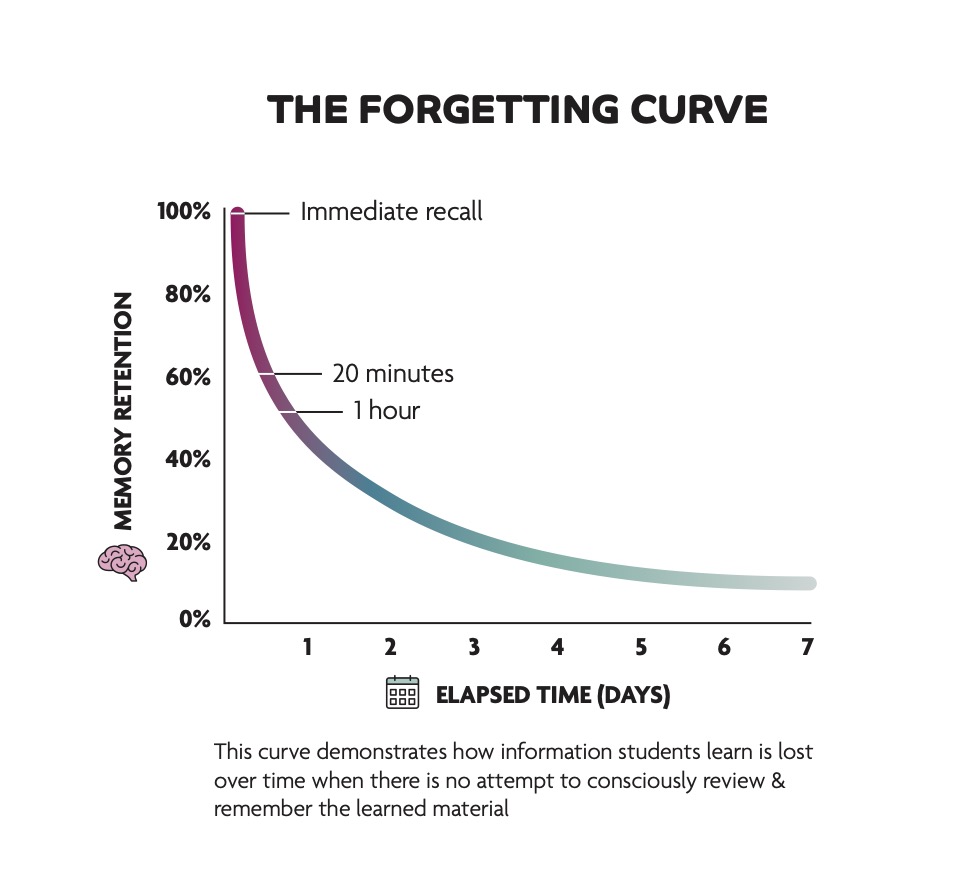
Memory falls off a cliff in the first day. After that the slope eases, but by then you've already lost most of what you read. This isn't a bug in your brain. It's how memory works.
Why reviewing fixes it
The same experiment showed something else, quietly. If you review the material right before you would have forgotten it, the curve resets. And the next time you forget, it decays more slowly. Repeat this a few times and information starts to stick the way a melody sticks. Effortlessly, permanently.
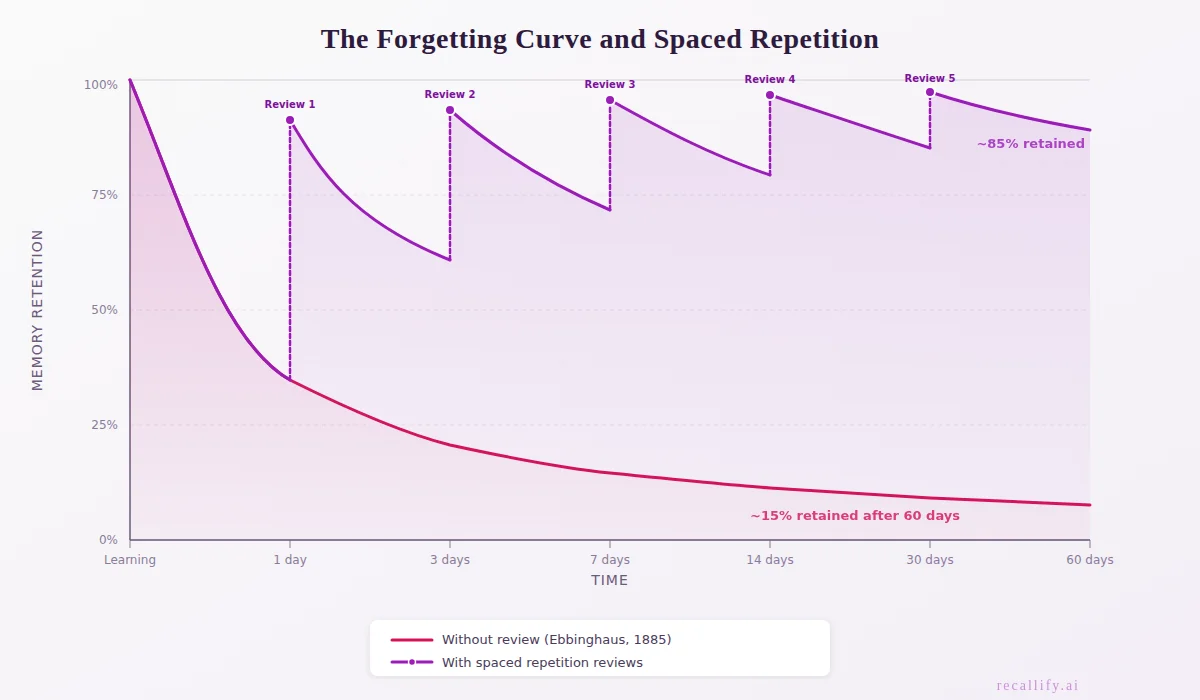
This is spaced repetition. It's been the single most replicated finding in memory research for over a century. It's also why flashcard apps like Anki work, when they work.
The problem with flashcards
Spaced repetition is real. Flashcards are a terrible interface for it.
You have to open an app. You have to write each flashcard yourself, in a specific front/back format. You have to carve out twenty minutes for a review session and plow through dozens in a row. Miss a day, the queue piles up. Miss a week, you never come back.
Most people don't have the discipline. That's fine. Atomus doesn't ask for it.
What Atomus does instead
Atomus takes the algorithm and drops it into the places you already are. You write atoms right inside your notes, one line each, or let AI draft them from a line of text if you want. When it's time to review, an atom drops from your notch while you're working on something else. A key or two, and it's gone.
No review session to schedule. The reviews come to you, a few at a time.