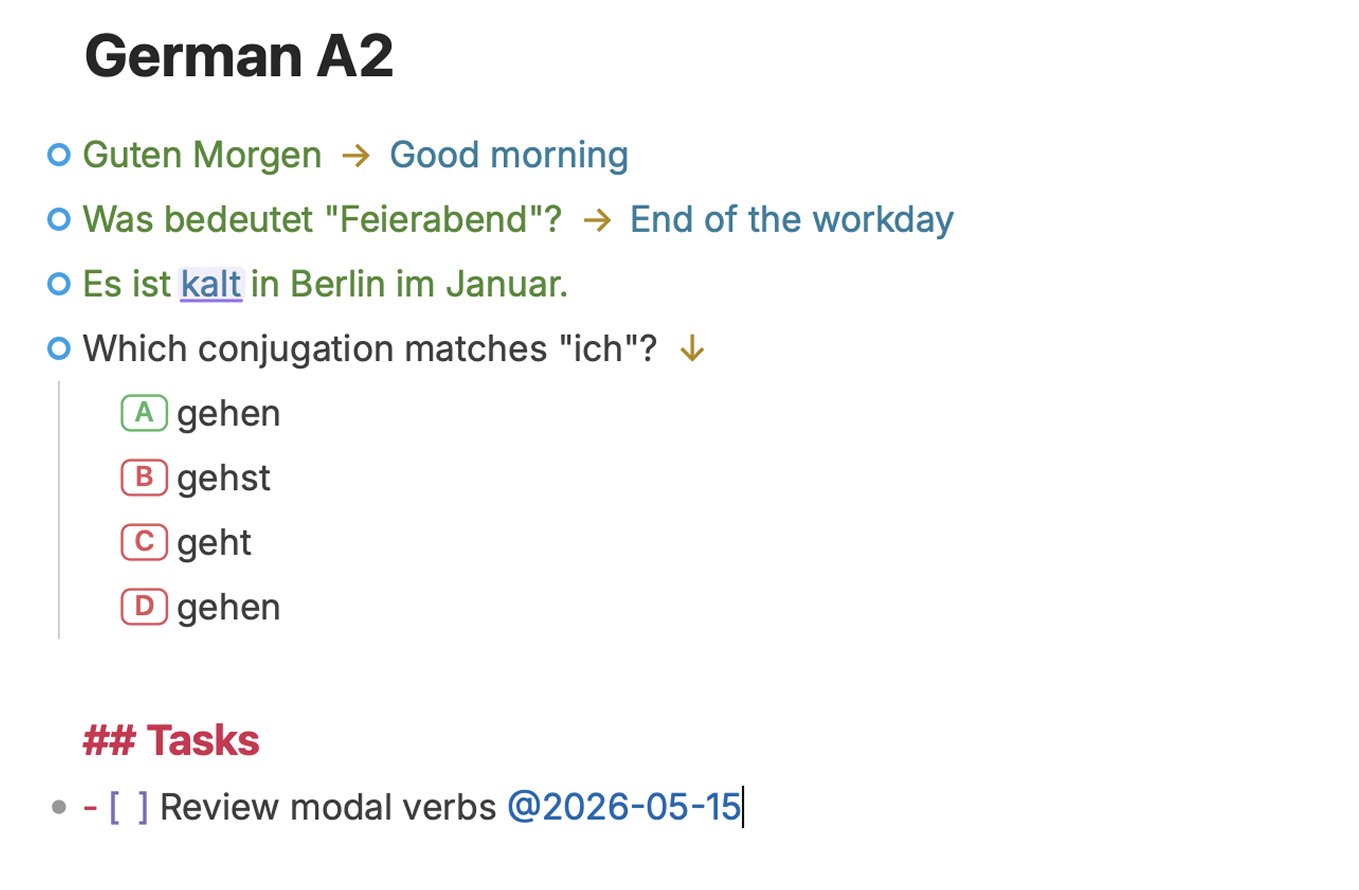

I tested every Obsidian flashcard option I could find. Six native plugins. Three sync-to-Anki tools. Three external apps that read your markdown.
This post is the honest breakdown. It's opinionated. It tells you which one to use depending on what you actually care about: file purity, mobile, FSRS, free vs. paid, integration depth.
Obsidian flashcards in 2026 fall into three categories: in-vault plugins, sync-to-Anki bridges, and external apps that read your markdown without touching it. Every credible option uses FSRS now. The hard choice isn't the algorithm. It's what you let the tool do to your notes.
Obsidian flashcards are spaced repetition cards created from plain markdown files inside an Obsidian vault, either via a community plugin that schedules reviews in-vault or via an external app that reads your .md files without modifying them.
The three paths
Pick your path first, then pick the tool.
- Everything in Obsidian. You want a single app, no external dependencies, mobile review when you commute. Trade-off: most plugins write scheduling metadata into your
.mdfiles. - Obsidian + Anki. You already have an Anki collection or want Anki's mature mobile apps and shared decks. You use Obsidian to write, Anki to review.
- Obsidian + a separate review app. You want clean notes, modern UI, and the review tool to read your files without modifying them.
The post is structured the same way.
Native Obsidian plugins (everything in your vault)
obsidian-spaced-repetition (st3v3nmw)
The original. 2,300+ GitHub stars, active maintenance (v1.14.1 in April 2026), and the most thorough Obsidian flashcard implementation by a wide margin. Note-level and card-level review, rich customization, FSRS available alongside the legacy SM-2 default.
- Strength: most mature; works on mobile; biggest community.
- Weakness: writes YAML metadata directly into your
.mdfiles. Your notes become a hybrid of content and bookkeeping. - Best for: Obsidian users who want maximum integration and don't mind file pollution.
Decks (dscherdi)
A cleaner FSRS-native plugin. Card syntax is header-paragraph or table. Schedule data lives separately. v1.7.5 shipped April 30, 2026.
- Strength: FSRS out of the box; minimal note modification; clean table format.
- Weakness: smaller community than
obsidian-spaced-repetition; less battle-tested. - Best for: spreadsheet thinkers who want FSRS without the SM-2 legacy.
Sprout (ctrlaltwill)
Submitted to the official plugin repo in February 2026. Full FSRS, Anki import/export, study analytics, image and LaTeX support.
- Strength: most polished new entrant; broadest feature set; minimal note modification.
- Weakness: too new to have accumulated bug reports; mobile support unclear.
- Best for: users who want a modern, all-in-one flashcard app inside Obsidian.
Come Through
FSRS with custom code blocks. Cards span multiple notes via paired front/back IDs.
- Strength: unique cross-note linking via IDs.
- Weakness: custom syntax probably won't render on mobile; limited public maintenance signals.
- Best for: developers comfortable with custom markup who want connected cards.
Spaced Repetition AI
FSRS plus an OpenAI integration that generates cards from your notes automatically.
- Strength: bulk card generation from existing notes.
- Weakness: requires OpenAI API key; embeds card markup back into your files.
- Best for: users who write long-form notes first and want to mine flashcards from them.
Better Recall (FlorianWoelki)
Anki-inspired. Decks, cards, separate database (no in-note pollution).
- Strength: keeps schedule data out of your markdown.
- Weakness: less active; algorithm is Anki-style, not pure FSRS.
- Best for: Anki refugees who want the Anki UX inside their vault.
Sync-to-Anki bridges (use Anki for review, Obsidian for writing)
Obsidian Anki Synchronizer (debanjandhar12)
Two-way sync. Notes, folders, and tags map to Anki structure. Anki has to be running for sync to fire.
- Strength: bidirectional; keeps Anki's review history intact.
- Weakness: adds Anki-compatible markup to your notes; sync conflicts if both apps are open.
- Best for: Anki power users who want Obsidian as the writing layer.
Auto Anki (ad2969)
Uses GPT to generate Anki cards from selected text. One-way push via AnkiConnect.
- Strength: fastest path from raw notes to Anki cards.
- Weakness: requires AnkiConnect server running locally; GPT-generated cards often need editing.
- Best for: Anki users who write long notes and want bulk card generation.
Awesome Flashcard
One-way Obsidian → Anki. Last updated three years ago. Skip it.
- Strength: was simple when maintained.
- Weakness: abandoned; potential compatibility issues with current Obsidian and Anki versions.
- Best for: nobody, in 2026.
External apps that read your markdown
Mochi
Markdown-aware spaced repetition app. Desktop, mobile, and web. FSRS in beta. $8/month or free with limits.
- Strength: cross-platform sync; polished UI; native mobile.
- Weakness: original simple algorithm was criticized for poor recall help; FSRS still in beta; cloud-first.
- Best for: students and professionals who want a polished, modern Anki alternative across devices.
RemNote
Outliner plus spaced repetition in one workspace. SM-2 or FSRS, your choice. $8/month or $395 one-time.
- Strength: deeply links cards back to their original context; bidirectional graph.
- Weakness: not markdown-native (proprietary format); steep learning curve; can feel like overkill if you just want flashcards.
- Best for: knowledge workers who want a single workspace for notes, cards, and links.
Atomus
Atomus reads your existing markdown without modifying it. FSRS-native. Reviews appear from the macOS notch. Local-first, $29 one-time, no subscription.
- Strength: zero plugin pollution. Your
.mdfiles stay yours; FSRS by default; notch-based reviews don't break flow; works directly on your Obsidian vault. - Weakness: macOS only; no mobile app; paid.
- Best for: Mac-using developers, designers, and PMs who already use Obsidian and want clean notes plus serious FSRS scheduling without any plugin overhead.
The plugin pollution problem
Seven of the ten in-vault solutions write metadata back into your .md files. This sounds minor and isn't. After a few months of reviews:
- Git diffs become 80% scheduling timestamps.
- Migrating to another tool means writing a script to strip every comment.
- Vaults synced across devices hit conflicts on schedule data, not real edits.
- Notes lose their "just plain text" property, the thing that made you pick Obsidian in the first place.
The architectural alternative: a tool that reads your markdown without writing back to it. Decks, Sprout, Better Recall, and Atomus are the four options that respect this. Atomus is the only external app of the four, which means it never even has the chance to modify your vault, because it doesn't own it.
Comparison table
| Tool | Algorithm | Mobile | Modifies notes? | Price | Active in 2026? |
|---|---|---|---|---|---|
| obsidian-spaced-repetition | SM-2 (FSRS opt-in) | ✅ | ✅ writes YAML | Free | ✅ |
| Decks | FSRS | ✅ | ⚠️ minimal | Free | ✅ |
| Sprout | FSRS | ❓ | ⚠️ minimal | Free | ✅ (new) |
| Come Through | FSRS | ❌ likely no | ⚠️ minimal | Free | ❓ |
| Spaced Repetition AI | FSRS | ❌ | ✅ adds markup | Free + OpenAI key | ✅ |
| Better Recall | Anki-style | ❌ likely no | ❌ separate DB | Free | ❓ |
| Obsidian Anki Sync | Anki | Anki only | ✅ adds markup | Free | ✅ |
| Auto Anki | Anki + GPT | Anki only | ❌ reads only | Free + OpenAI key | ✅ |
| Awesome Flashcard | Anki | Anki only | ⚠️ minimal | Free | ❌ abandoned |
| Mochi | Custom (FSRS beta) | ✅ | ❌ separate app | $8/mo or free | ✅ |
| RemNote | SM-2 or FSRS | ✅ | N/A (not markdown) | $8/mo or $395 | ✅ |
| Atomus | FSRS | ❌ macOS only | ❌ never modifies | $29 once | ✅ |
Which to pick
Skip the meta-decision. Pick by user type:
- One app, mobile review, don't care about YAML in your notes: use obsidian-spaced-repetition. Most battle-tested, largest community.
- Everything in Obsidian, clean notes: use Sprout or Decks. Both are FSRS, both keep schedule data out of your
.mdfiles. Sprout is more featured, Decks is more minimal. - Existing Anki collection: use Obsidian Anki Synchronizer. Two-way sync, Anki stays the source of truth, Obsidian is the editor.
- Polished cross-device review, no Obsidian dependency: use Mochi.
- Single workspace for notes, links, and cards: use RemNote.
- Mac, Obsidian, FSRS, and you want your notes untouched: use Atomus. If you want to understand why FSRS outperforms SM-2, read the FSRS vs SM-2 breakdown. The notch reviews are a real quality-of-life improvement if you live in your editor.
The honest version: the "best" depends on which trade-off you can live with. Plugins win on integration. External apps win on note hygiene. Atomus wins for one specific persona: Mac-using engineer or designer in Obsidian who hates plugin pollution and wants reviews to surface without breaking flow. If that's not you, one of the other twelve options is probably better.
Key points
- Obsidian flashcards in 2026 split into three paths: in-vault plugins, Anki bridges, external markdown apps.
- FSRS is now standard. Every credible new tool ships it. Anki adopted it as default in 2024.
- Plugin pollution is the real architectural choice: most in-vault plugins write scheduling metadata into your
.mdfiles, which costs you in git diffs, migration, and visual noise. - The four pollution-free options are Decks, Sprout, Better Recall, and Atomus. Atomus is the only external app of the four.
- Pick by your trade-off: integration depth (in-vault plugins), Anki ecosystem (sync tools), or note hygiene (external apps).
FAQ
What is the best Obsidian flashcard plugin in 2026?
There's no single best. It depends on what you optimize for. Sprout and Decks are the cleanest FSRS plugins. obsidian-spaced-repetition is the most mature with the best mobile support. For Mac users who want clean notes plus FSRS without any plugin pollution, Atomus is the answer.
Does Obsidian have native flashcards? No. There's no built-in flashcard feature. Every flashcard solution is either a community plugin (in-vault) or an external app that reads your markdown. The community has been requesting a native feature for years.
What is plugin pollution?
It's when a flashcard plugin writes scheduling metadata into your .md files, commonly as YAML frontmatter or HTML comments. It pollutes git diffs, makes vault migration harder, and adds visual noise to your notes.
Does Obsidian-Anki sync work both ways? Obsidian Anki Synchronizer (debanjandhar12) does two-way sync. Awesome Flashcard is one-way only and hasn't been updated in three years. Auto Anki uses GPT to generate cards but only pushes one-way.
Is FSRS better than SM-2? Yes. FSRS needs 20–30% fewer reviews than Anki's classic SM-2 to maintain the same retention. Anki itself adopted FSRS as the default in 2024. In 2026, every credible new solution ships FSRS first.
Can I use markdown flashcards without any Obsidian plugin? Yes. External apps like Mochi, RemNote, and Atomus read markdown files directly. Atomus reads your existing Obsidian vault without modifying any files. Your notes stay clean and your reviews happen out of band.
What I use
I use Obsidian for thinking, Atomus for reviewing. The vault is a folder of .md files I've been writing for three years. Atomus reads that folder, schedules atoms with FSRS, and slides reviews down from the notch when they're due. My notes haven't been touched by a plugin in six months and the git history makes sense again.
If you're on a Mac and you want the same setup, give Atomus a try. If you're not, one of the eleven options above is probably the right answer for you. None of them are wrong; they just optimize for different things.